I was born in 1934, a period when the Great Depression was just beginning to take its toll in Canada and around the world. It was a time when many businesses went bankrupt and jobs were hard to find. Cash was scarce, but we were very fortunate that we lived on a farm.
Our farm was over 100 acres, a good part of it maple bush and another part cedar swamp. In that one sentence, I have defined the path to survival for a large family like the Hendersons.
Mixed farming meant that we had plenty of food all year round. We milked six cows by hand and sold the milk to the cheese factory. Every morning my father got out of bed around 6 a.m., started the wood fire in the cook stove in the kitchen and went out to the barn. When I was old enough to milk cows, the rest of by brothers and sisters had left home, so he would call for me to get up and help with the chores. Recent research has proven what I knew instinctively –teens need their sleep! I hated getting out of bed.
After the milking was done, the milk was strained into cans, which were set in a water trough at the well pump. We would pump cold water using the hand pump into the trough to cool the milk for shipping. A truck would pick up the cans of milk at the highway and leave us yesterday’s cans. The milk cheque was a major part of the income for the farm. But the milk also meant that the family had lots of milk to drink, fresh and unpasteurized, as well as cream and butter.
Hens produced eggs, pigs produced pork, and beef came from the slaughter of a fat heifer in the fall. Of course we had chicken pot pie on occasion and sold the eggs to the egg grading station, which was also the grocery store. The payment for the eggs went towards paying the bill for groceries. Since we had no electricity, we rented a locker from the butcher in Spencerville and stored the beef, as well as berries and other food, in that commercial freezer.
The huge garden produced great organic vegetables and enough potatoes, carrots and turnips to last the winter. We ate well in a period when men walked in desolation from place to place looking for work. Many a "tramp" stopped to see if he could work for pay or food. No pay was available, but Mother always gave them something to eat.
The other two cash crops that the farm produced were cedar posts and maple syrup. There was an advantage to living in a swamp –cedar trees love it. Farmers from the less swampy areas of Ontario would come and buy the rights to a plot where they would cut cedars for fence posts. Cedar is almost impervious to water and, therefore, make great posts.
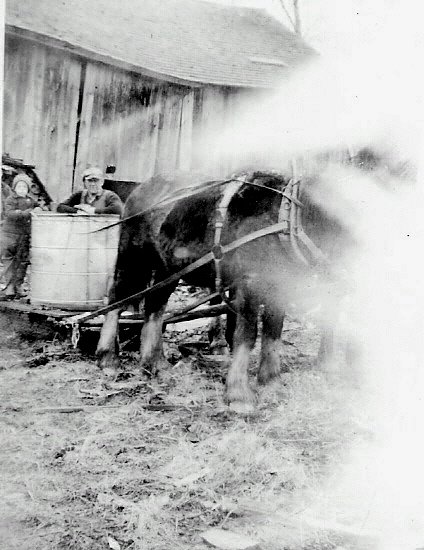
The maple sugar bush provided a fairly large influx of cash in March when the sap would run. In the photo you can see my father and I, as a little boy, on the sleigh with the tank for gathering sap from the 900 trees that had been tapped. Gathering sap was a hard job mitigated only by the glorious sunny March days that signalled the trees that it was time to wake up and greet Spring.
We used horses to pull the sleigh through the deep snow in the woods. I remember wading in snow almost to my waist with a sap pail used to empty the buckets on the trees and carry it to the tank. From there the full tank was pulled to the shed where the evaporator steamed. It takes forty gallons of sap to make one gallon of syrup, so a hot fire is required.
My father did the boiling and a hired man gathered the sap. The basic fuel was wood, again from the bush on the farm, but we needed coal added to make the fire really hot. To boil the sap, my father used a large shed that had been used to tie up horses behind a church. The church had disappeared, but the shed remained and served for many years as the sugar shanty. One of its great benefits was that it was right on the highway. People would stop and buy the freshly made syrup by the gallon or by the quart bottle. We used old whiskey bottles, which many people would return to be refilled.
The syrup provided needed cash through the years that my father made it. Spring was a flush period, relatively speaking. Naturally we stored several gallons for family use. My father had a sweet tooth and so there was always a pitcher of maple syrup on the dinner table.
Isn’t it ironic that I and my family grew up eating organic vegetables, free range chicken and uninjected beef, which is premium food now.


No comments:
Post a Comment