The Good Olde Days


No Electricity

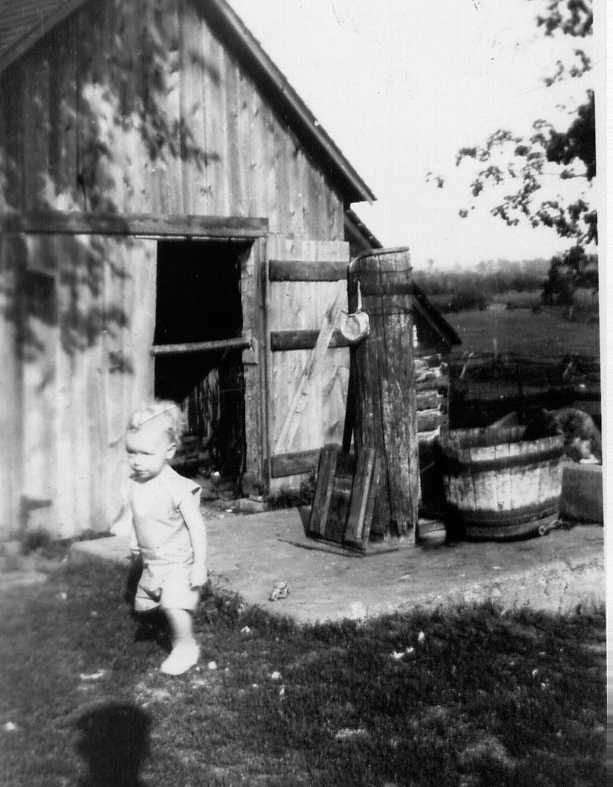
We had no electricity on the farm until after the war. Today it is almost impossible to appreciate the problems that people had due to lack of that magical power. Of course, we had not known anything else, so it didn’t seem strange. But it was hard work!
There are no pictures in the family albums taken inside the house or barn because there was no light there and cameras were fairly primitive by today’s standards. Pictures were taken outside in the sunlight.
We used kerosene lamps for light on those long cold winter nights. These are the lamps that people buy now as backup light at their cottage or just for decoration, for many lamps were beautifully designed. I remember cleaning the black soot from the glass chimney with newspaper when I had reached the age where I would not drop them. We had one Aladdin lamp, which was not magic at all, but it did give a very bright light. Since I was a great reader, this was an important educational tool.
Of course, we heated the house with wood using a cook stove in the kitchen and a Quebec heater in the parlour. There were only two rooms on the main floor of the house and three bedrooms upstairs. Every fall we would fill the wood shed with good hardwood to keep the place warm through those icy winters. There was no furnace or even a fan of any sort to move the warm air around. Coming in from the cold with frozen feet created a close relationship with the stove even to the extent of feet in the oven.
Since cooking was done using wood, having a good hot fire was important. I remember my mother sending me out to get an armload of small maple poles from the wood shed so she could control the heat to the oven so the bread would not fall. In summer, we moved out to the summer kitchen which was airy and cooler than the main house. The cooking still had to be done with wood, but the hot air was exhausted through the large screened windows.
One of the largest problems we had was the cooling of food. Without a refrigerator, we used an ice box. In the winter, we would cut ice from a river and draw it to the ice house by the barn. Buried in saw dust, ice would remain solid all summer. When needed, a block would be uncovered, washed off and placed in the ice box. This worked remarkably well, but there was no freezing available except by renting a locker at the butcher’s in town. That meant a lot of canning took place during the summer.
Of course there were no power tools without electricity, so everything was done by hand from sawing to drilling to pumping water. The Kingston family were great wood and metal workers, so when something had to be constructed we got them to do it in their well-equipped shop just up Buckwheat Row.
We did have a telephone. It was a huge party line with many of our neighbours sharing the service. The telephone was powered by dry cell batteries and to ring someone, you had to crank the handle on the side. Everyone had a different ring, but everyone could hear all of the rings. And when you picked up the receiver, you could hear the conversation going on.
Also, the ring from central in town was stronger because they had electricity and just pushed a button, so when a long distance call came, we knew. So did everyone else. Our ring was two longs, and when by brothers and sisters were away other people would pick up when they heard our ring to get the latest news on the family. The problem with that was that the more receivers that were open the fainter the sound. We had to admonish certain neighbours who were inveterate listeners and ask them to hang up so we could hear George or Ray or whoever. That was not fun. The fun was in listening in on other folks.
Of course we had no television, but we had radio, and this was the golden age of entertainment radio. Amos and Andy, Fibber McGee and Molly, The Green Hornet, Lux Radio Theatre, and the good old CBC. The Marconi sat by the wondow with my father’s rocking chair in front of it. That radio was the centre of attention every evening, although I was not partial to the farm broadcasts at 12:00 noon.
The radio was powered by a car battery that we took into Spencerville and had recharged at the garage while the rest of the shopping was done. It is amazing how resourceful we were in those days before the coming of electricity.
The Garden of Groveton

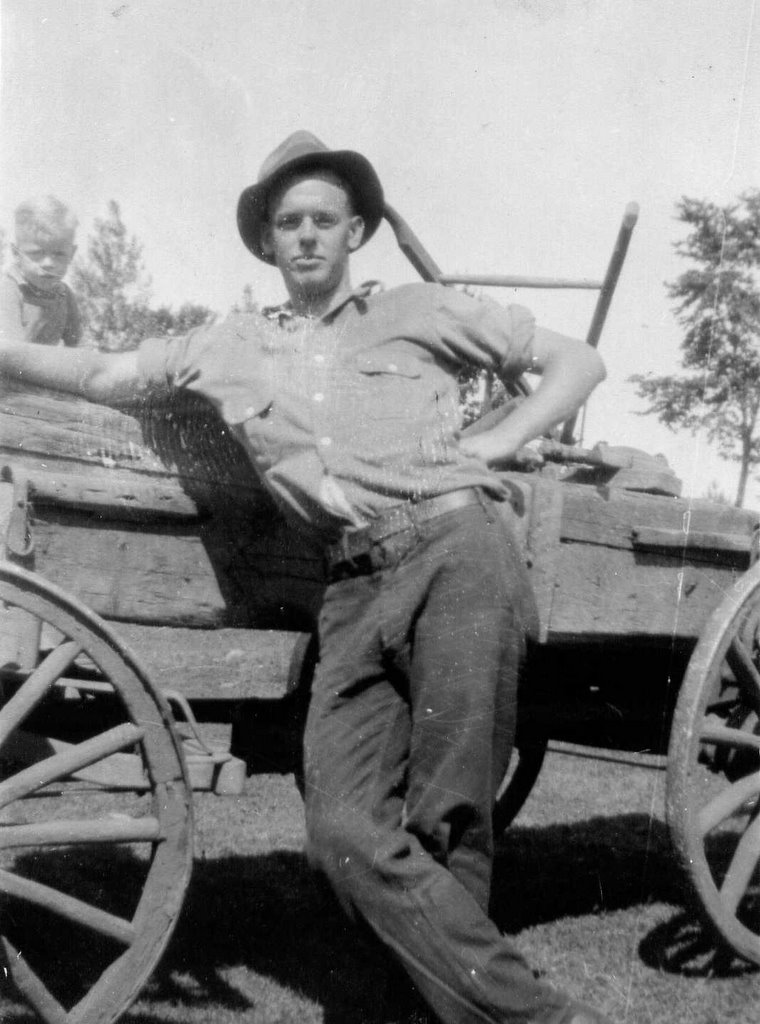
One of the greatest advantages of living on farm during the Great Depressions of the 1930's was that we had lots of food –very little money, but lots of food. Ironically, it was all organically grown and free range. The cows and chickens got lots of fresh air and exercise.
Today organic vegetables are regarded as premium food and free range chicken costs more. Okay, so it’s better and better for you, but you pay. We didn’t even imagine a day when chickens would be like laying machines caged so they cannot move and that vegetables would be grown in hot houses in California to be flown to our urban supermarkets.
You have heard the expression, "Eat Local." None of those New Zealand apples for us. We ate the ones from our own trees. Although we did occasionally eat a few from Willie Smail’s orchard just down the road. The Smails used to watch their orchard very closely, but they lived quite a way from it, so Dorothy used to get me to go with her to secure some of their Macs. We would creep through the woods and slip into the orchard from the rear, pick a few ripe ones and exit the same way. Although they were excellent apples, we didn’t really need them and we know Mother would frown if we told her what we had done. It was the fun of it that counted, and the thrill. Thrills were not easy to come by in the Garden of Groveton.
In our garden we grew great, huge red tomatoes, cucumbers, radishes and onions that we would eat raw and in great quantities all summer long. The potatoes, cabbage, carrots, parsnips and turnips could be stored for winter eating in our cellar. I remember dumping wagon loads of potatoes down a chute into a huge bin in the cellar and then going down into that cold, dark place in December to pick out a pot full for Mother.
The chickens were kept in the chicken coop. Where else? They would range out into the yard to pick and peck, but at dusk they ducked back through the hen door and reserved a spot on a roost for the night. The roosters mingled with the hens. When Mother wanted one for Sunday dinner, I would be dispatched with a sturdy coat hanger opened out with the end bent into a hook. The trick was to pick out a nice plump rooster and snag him by one foot with the hook. There would be lots of wings flapping and hens running and dust rising, but that rooster must die!
We had a block of wood resting on its end behind the house with an axe leaning against it. There was no point in being squeamish when chicken pot pie was promised. Off with its head and into the scalding water to pluck the feathers. Premium quality fresh free range chicken for supper –we called the meal at night supper– with organically grown potatoes and carrots on the side.
We ate okay, Depression or no Depression.
Buckwheat

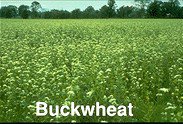
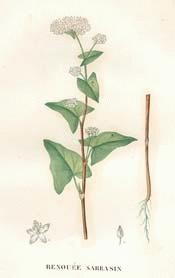
We called it Buckwheat Row, but when they finally put up official signs during the 911 startup, they called it Buckwheat Road. "Road" is likely the proper designation, but it is not much of a road, a narrow, muddy, gravel, potholed track joining the highway at Groveton to the path that leads into the Huckleberry Marsh only two miles away.
The question is how did it get its name? Why "buckwheat"?
The area is called the Groveton Bog, which suggests rather low, wet land imperfect for farming. Indeed it is stony and light where it is not muddy and wet. It is poor land that the Scots who came here in the 1800's looked on favourably. How did the pioneers know? It was covered by forest when they first saw it.
Buckwheat grows just about anywhere, so it would flourish around the Groveton area. It came originally from Asia, then to Europe and at last to Canada. It is an edible grain, both for human and animal, and it has other purposes.
The whole grain can be fed to hens, and it can be cracked to be mixed with other grain for a balanced poultry food.
Buckwheat has a nutty flavour when cooked, kasha being the dried and toasted buckwheat groats. Kasha is used in midEastern dishes, very delicious and easy to make. Even as I write this, Judy is preparing kasha for supper.
Buckwheat is also milled to make the flour especially used to make pancakes and crepes because of the texture and taste, in particular, Galettes de Sarrasin which are basic French crepes made with buckwheat flour. One time we were in France, we stayed overnight in a small city on the Loire and, after finding a hotel room near the river, we strolled around to find a restaurant. We sat down on the patio of La Galette, a restaurant specializing in crepes but featuring Galettes de Sarrasin. They were delicious. You can Google the name for a recipe.
Do we need other purposes for buckwheat? They exist. The buckwheat flower is large and much favoured by bees, so that buckwheat honey can be seen on store shelves. It is dark with a strong taste.
Growing buckwheat has another unusual use that I recall from those farming days long ago. It grows very quickly and is very thick and green. It beats weeds! After growing a crop of oats on a field, sometimes a crop of buckwheat was grown to kill off the weeds, and then at fall plowing time the thick green plants were ploughed under to provide humus to the soil making it richer for a planting the next year. It was similar to letting the land lie fallow but with a super bonus. It was a natural, organic way of getting rid of the weeds and enriching the light soil.
So, why not call it Buckwheat Row?
The Huckleberry Marsh
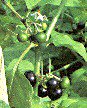
Buckwheat Row is only about 2 miles long, running from Groveton on Highway 16 to the Huckleberry Marsh. There is no road through the marsh, so you have to turn around and bounce back to the highway over the potholes in the narrow gravel road that serves a dozen farms.
The senior Mr. Kingston was the harbinger of ripe huckleberries. He would walk into the marsh and when they were ripe in June he would spread the news, which was not as difficult as it would seem since we had a party line that included the whole area. The party line served the function that the Internet serves today –spreading the news!
Huckleberries are different from blueberries, darker in colour and growing on quite high bushes, but tasting a lot like wild blueberries and serving the same function in pies and on the table. We would travel there by horse and wagon, usually as a whole family, carrying milk pails to pick in. It was a long walk from the end of the road out into the marsh requiring rubber boots and lots of energy.
The great thing about picking huckleberries is that they grow on bushes, not near the ground as wild blueberries do, so filling a pail did not take all that long. They grow in bunches as the picture suggests, so they can be collected by the handful. The struggle was to get those huge pails brimful with ripe berries back to the wagon safely.
Needless to say we ate lots of berries while we picked, for huckleberries are juicy and rich. But the huckleberry shortcake and the pie was what we really looked forward to as the reward for picking.
Maple Syrup
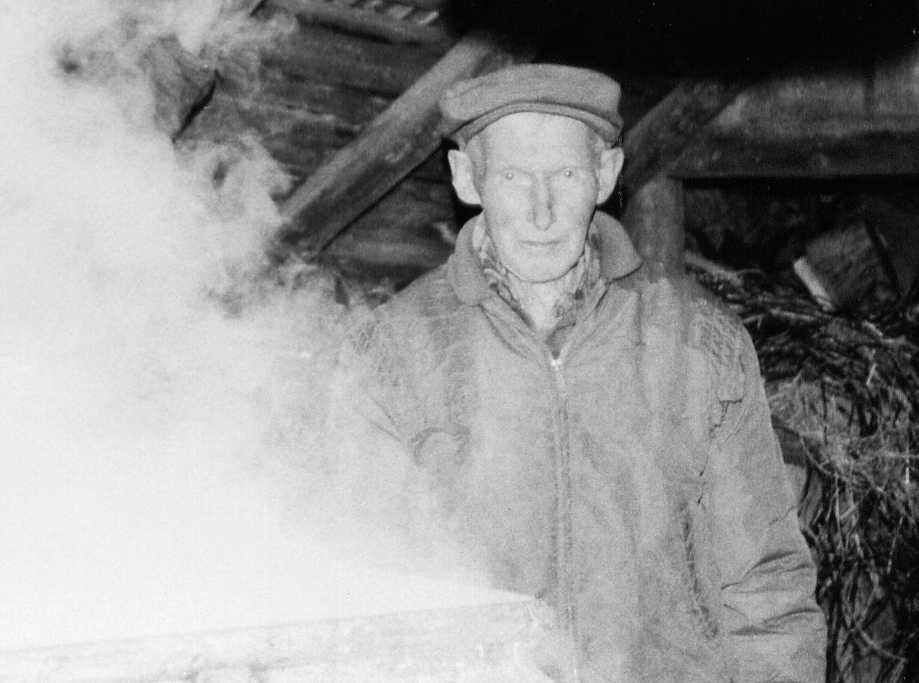
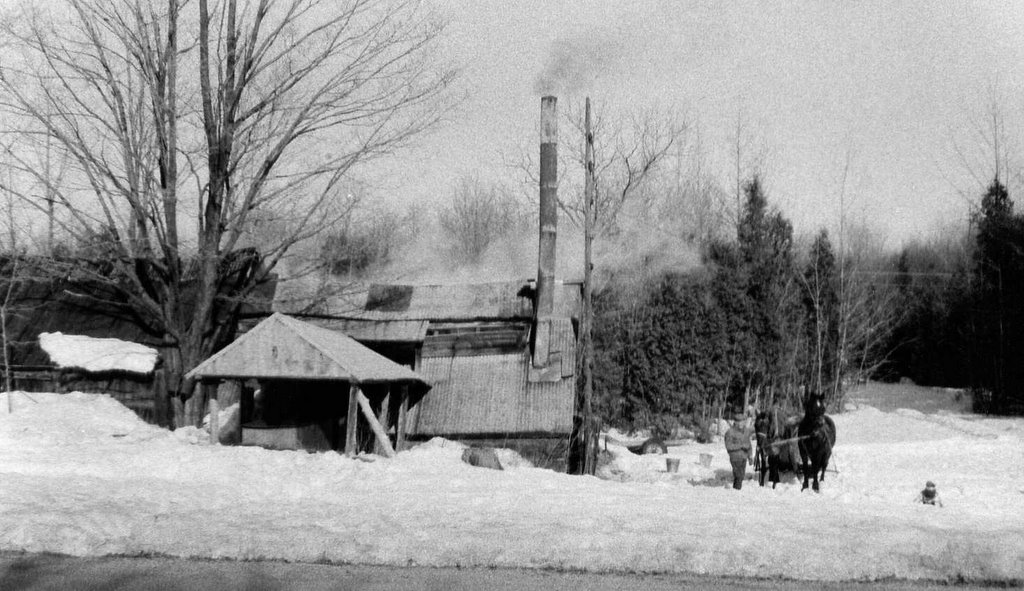


Willie Smail was our next neighbour to the south along Highway 16. He had a maple sugar bush across the highway from us with the sugar shack near the sharp corner in the highway.
The pictures show him boiling the sap to make syrup. To accomplish that, he needed a very hot fire in the evaporator, since the ratio of sap to syrup is 40 to 1. As my father did, Willie used a thermometer to decide when the syrup was ready to be drawn off, filtered through a special felt filter and bottled or canned.
We visited his place in March 1977 on our way to Ottawa. It must have been March Break, because Scott and Shelley are looking at the horses and Paul is just running around. Of course, that is Judy in the sugar shanty with Willie.
The horses were important to pull the sled with the tank on it to gather the sap from the trees. The snow was very deep in the woods, and the tracks between the trees were rough and deeply rutted. To gather the sap from the trees required a hardy soul to plunge through the snow to every tree, empty the buckets into a large pail and then return to the tank to dump it in. It was icy cold, wet work.
Although the job of running the evaporator was the nicest one in many ways, it seemed never ending. When the sap was running, it was difficult to keep up with it, and Willie would boil long into the night.
This kind of operation ended in Groveton when our father and Willie Smail retired.
Snow
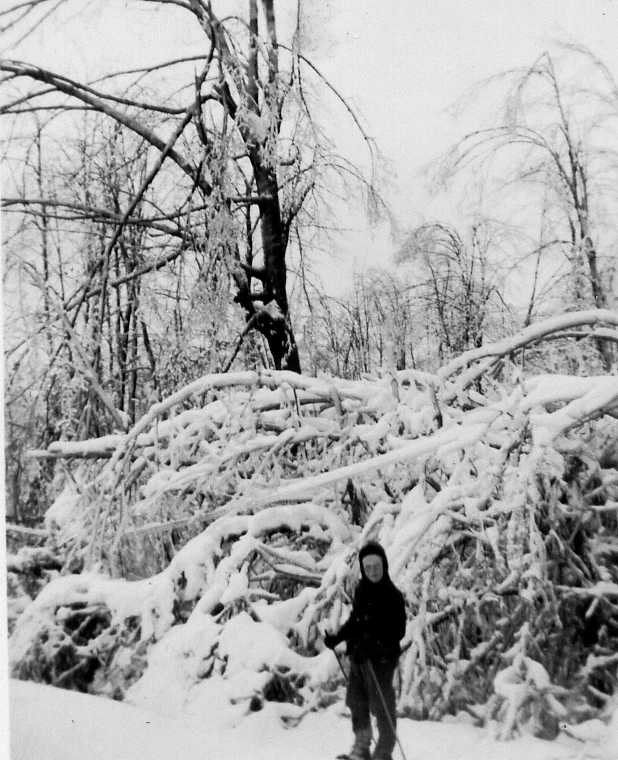
How do I remember snow? Let me count the ways.
.
Waist deep, piled high, roads blocked, sledding down hill, ice. Lots of all of it with me in the picture on skis after an ice storm.
Waist deep, piled high, roads blocked, sledding down hill, ice. Lots of all of it with me in the picture on skis after an ice storm.
.
Winters seemed to be longer, colder and snowier than they are now. I remember snow being waist deep in our yard, but I suppose at 5 years of age my waist was closer to the ground than it is now.
Since the schoolyard was on a hillside, there was an excellent run down on a sled. We used to take our sleds to school and spend recess running up the hill and sliding down. Having a fast sled was very important. Occasionally, on a really fast day, we would slide down the hill at speed, dip under the fence into the ditch beside the highway and see if we could make it up over the snow bank to the pavement. Pretty dangerous stuff, but we loved it.
Just as there was no water to swim in, there were very few ponds to skate on. I would trek a mile or more up Buckwheat Road to a pond on the Gray property where I would meet Keith and Harold and a few others to play pond hockey. No Zamboni there –shovels and sweat. It was so cold changing from boots into skates that our hands would just about freeze.
When the snow plow went by on the highway, it threw the snow up into immense banks. To get our car out of the garage and onto the highway, we had to dig a passage through those high banks, hitch a team of horses to the car and drag it out. Quite often the car would not start, but with horses that didn’t matter. We would pull it onto the highway, slide it into second gear and let out the clutch. Once it started we couldn’t shut it off.
Old car, cold weather, and deep snow.
The Barns Are Gone

The satellite picture shows the entire area with Groveton at the cross roads of County Road 44 and Groveton Road to the Ventnor Road where the Cummings lane leads northward to the white dots in the middle of the picture that are the barns and house.
What was a farm in Groveton is now grown up to trees and bush. The house stands, but the barns are gone.
Eatons Catalogue
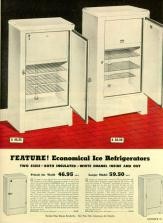
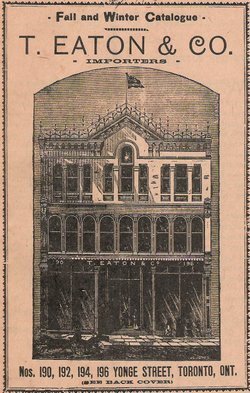
The famous Eatons catalogue started with this cover in 1884 and contained most of the essentials for Canadian life, including the "ice refrigerators" in the picture, better known as ice boxes to us.
Living in the country made shopping difficult, so that even furniture and pianos could be ordered and they would deliver it to the door. I still have six press back chairs, rescued from the farm when Mother moved out, that most likely came from Eatons when they were setting up house.
But the Eatons catalogue had other uses. It was a toy. I remember that, when I was a very young boy visiting a certain aunt Belle with my mother, I was given the catalogue and told to amuse myself. Hers was a household where little boys were not heard and were seen as little of as possible.
But I think the most contact I had with the pages of the catalogue was in the outdoor toilet. When the new catalogue arrived, the old one was recycled by being relegated to the toilet in the absence of the kind of gentle, soft tissue we have these days.
Oh, we had it hard in those days. It’s a wonder we survived!
Fishing

Where I grew up, fishing mostly meant fishing for mudpout. Mudpout is the local name for a fish that abounds in Southern Ontario, and is also known as bullhead, catfish, barbotte and mud cat.
And the rule of thumb was, "They only bite when the mosquitoes do!"
The equipment was simple, a pole a line, a hook and a can of worms. Of course, a drive to the river was essential, and it had to be at dusk.
Catfish, or mudpout as we called them, live in slow moving, warm water, the kind you find in the small rivers of Southern Ontario. We used to go to branch of the Nation River and toss in the worm. In between slapping the mosquitoes, we would pull in the lines and fill a bucket with fish. People boasted of the number they caught the night before, and under a hundred was a pointless boast.
Mudpout are easy to clean, which includes skinning them. We used to clean them all and fry up a batch in butter. The fillet comes off the bone easily in one piece, and the next boast was about how many you could eat at one sitting.
Fresh mudpout is hard to beat. They are delicious!


Wednesday, December 28, 2005
Strawberry Jam


There is nothing as sweet as wild strawberries.
I remember going picking strawberries in the warm July sun, sitting on the ground and delicately pinching off those tiny berries and dropping them in a small container –my mouth! I used to eat more than I picked, but still the object was to get enough home to fill a strawberry shortcake made with whipped cream from the farm.
This was all before the days of cultivated strawberries, which I have to admit now can be very good indeed, especially in the middle of February in the form of freezer jam or just thawed berries over yogurt or ice cream. In the days before electricity and freezers, it was preserved jam that carried that great taste over into winter.
We used to buy sugar in 100 pound bags and stand them behind the hall door with the 100 pound bag of flour. A lot of preserving went on in the days before refrigerators, all of it stored on shelves in the cellar just across from the bins of potatoes and cabbages. Throughout summer and fall, my mother would spend hours over a hot fire with the preserving kettle steaming away. The results were spectacular.
But of all of the preserved jams and food, the most delicate and the richest was the wild strawberry jam.
Tuesday, December 27, 2005
Voting

When election time comes around now, it makes me recall what people used to say when I was too young to vote. My father (shown here sitting on that '31 Buick) was returning officer for more than one election, the vote taking place in the Groveton school house.
My father was a liberal, as I recall, and I guess my mother was as well. In any case, it was not a topic of much conversation at the table, so they were amicable about it. Not so every couple. "She killed his vote", they would say, when a wife voted opposite to her husband. This was an unpunished crime.
After the votes were counted, people would speculate on who had changed their vote. Everyone knew everyone else so well, that they could count up the votes to see who had switched parties and to check if anyone had killed her husband’s vote.
There is an up side to living in a small, stable community, and a down side, and election day always brought out the interesting side.
Sunday, December 25, 2005
Barry's Pancakes
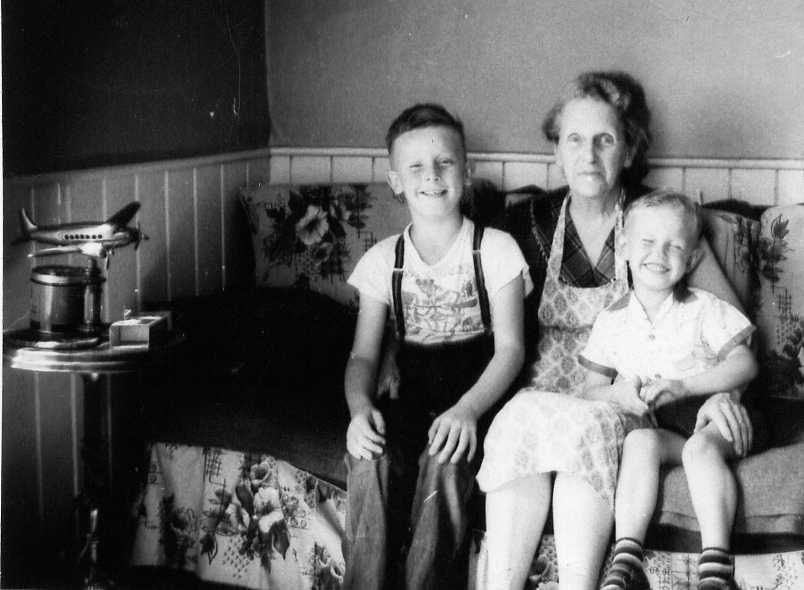
Madeline and Jim had four sons, two of whom appear in the picture. Doug, the eldest, is on the right side of his grandmother, and Barry is on her left.
Barry, who now lives in Oakville, has been reading this memoir/family history and has his own memories of visiting the farm.
He writes: Grandma Henderson made the best pancakes. I held the record among us kids of 14 eaten at one sitting. I'd like to try to break that record, but you can't get pancakes like that anymore.
Her porridge was delicious too. I still eat oatmeal everyday to keep the cholesterol down, but, when I make it, it tastes like wet cardboard. She used to stir in butter and cream and top it with maple syrup, of course.
I remember drizzling hot maple syrup from the evaporator on the snow and then eating it like candy when it hardened.
It seems most of my memories of visiting the Grandparents’ farm involve food.
Friday, December 23, 2005
Boarding the Teacher

You’ve seen the house where we were all born. It’s small by just about any standards. There were only two rooms on the main floor and only three bedrooms upstairs.
There was, of course, no basement, only a damp cellar with a large cistern for rain water to collect in and the bins for potatoes, carrots, cabbages and other winter food.
I remember picking the potatoes in the fall and dumping them into a wagon box, which was unloaded using a chute that ran from the wagon in through a cellar window to the potato bin. We ate a lot of potatoes!
The cistern was pretty important, since it collected rain water from the roof that we used for washing. It was nice soft water, great for the Saturday night bath, compared to the well water that was so hard it made the soap congeal.
When I grew up, I had a bedroom to myself and we actually had a guest room, but I wondered what happened when all five kids were there –and the teacher, because we boarded the teacher as an income in those hard depression years.
So where did everybody sleep? Well, the teacher had to have a room of her own, so that left two bedrooms. One bedroom was for the boys, of course. There were two double beds in my parents' room, so that took care of two of the girls. That left someone over. Dorothy solved the numbers problem by explaining that she slept at the end of the hall with the foot of her cot in a closet. The family plus the teacher was taken care of in this way.
The photograph shows my sister Madeline wearing the saddle shoes with the teacher standing in front of the Groveton school house door.
Tuesday, December 20, 2005
Bees

The photo of a mass of grandkids around the tractor pulling a wagon load of wood is the result of one of two very important bees that we had at the farm.
No, not the kind that sting; the kind that share. A bee is a gathering of neighbours to help either thresh the grain or saw the wood.
When trees were cut in the woods, they were hauled out into an empty space and piled up to wait for the sawing bee. The cutting usually took place in the winter when we could get around with horses and sleigh. We lived in a bog, remember. In the spring, the man with the saw and tractor arrived and set up in front of the pile of logs.
The invitation had gone out a few days before, so the neighbours arrived and set to work. It was intense, hard work carrying sixteen-foot logs to the saw and reducing them to sixteen inch blocks. That was only half the job, really. At a later date, someone had to split those blocks into stove sized wood and then move the whole lot into the wood shed in preparation for winter. That is what is happening in the photograph.
The other bee took place in the fall. After the grain had been cut, bound and stooked, the man with the threshing machine and tractor would arrive when it was our turn. The neighbours, usually the same ones, would arrive and the sheaves of grain would be brought to the barn and the threshing machine by horse and wagon.
The straw was blown into a mow in the barn to be used for bedding for the cattle over the winter. The grain was bagged and stacked in the granary to be ground at the water-powered grist mill in Spencerville. Again, it was hard, hot and dusty work.
When noon came, the men all washed at the pump and headed for the house where tables groaned with the weight of the food. And did they eat! My mother, assisted by two or three neighbouring ladies, would serve up the potatoes and meat and vegetables and bread and two kinds of pie and mugs of tea. It all disappeared like magic. Work hard, eat hard.
These farmers had to consume a tremendous number of calories just to keep going. The difficult physical labour required volumes of food, for after the bee is over and the grain is bagged, everyone rushed home to do the chores –milk the cows, feed the hens, clean the barn.
Bees were social occasions as well as socialist concerns. It was self-help and help one another, all on good spirits. Lots of talk, lots of laughs. This ready exchange of labour worked well. The result was a strong community.